1. Introduction1.1 The Importance of Enameled Wire Insulation TestingAs a core conductive component in motors, transformers and electronic devices, the insulation performance of enameled wire directly determines equipment reliability, safety and service life. Defects or performance degradation in the insulation layer can easily cause short circuits, equipment failures, and even safety accidents like fires and electric shocks. Therefore, systematic and rigorous insulation testing is crucial for ensuring electrical product quality, mitigating operational risks, and meeting manufacturing quality control and industry standard requirements.
1.2 Scope of Application and Core Objectives of This ArticleThis article is intended for enameled wire manufacturers, electrical R&D engineers and quality inspectors, systematically outlining the full process of enameled wire insulation testing. Its core goal is to help readers master pre-test preparation, key testing methods, result interpretation logic and safety specifications, ensuring standardized, efficient testing and accurate results for precise insulation performance evaluation and quality control.
2. Pre-Testing Preparation: Laying the Foundation for Accurate Testing2.1 Clarify Relevant Standards and Technical SpecificationsPrior to insulation testing, it is essential to clarify applicable standards to ensure test authority and comparability. Globally recognized standards include IEC 60317 (IEC), ASTM D1676 (ASTM) and MW1000 (NEMA).
Additionally, specific requirements based on application scenarios must be defined—for example, automotive enameled wires require high temperature and vibration resistance, while aerospace applications demand lightweight and radiation-resistant insulation. Core wire parameters (gauge, insulation material such as polyimide/polyester/polyurethane, rated temperature class) should also be pre-specified to guide test plan development.
2.2 Standardize the Sample Preparation Process2.2.1 Principles of Sample SelectionSamples should be randomly selected to represent the entire batch quality. Sample quantity is determined by batch size, standard requirements and testing needs to avoid result deviations from insufficient sampling.
2.2.2 Sample Handling and StorageDuring transportation, storage and handling, samples must be protected from insulation damage. Store in a dry, clean, corrosion-free environment with stable temperature and humidity; handle gently to avoid dragging, squeezing or rubbing the insulation surface.
2.2.3 Sample Preparation StepsSample preparation varies by test item, typically including cutting appropriate lengths, standard end stripping (without damaging remaining insulation), and cleaning surface oil/dust to ensure good contact between electrodes, conductors and insulation during testing.
2.3 Equip with Necessary Tools and Equipment2.3.1 Basic ToolsEssential basic tools include precision wire strippers (to avoid insulation damage), vernier calipers (for wire diameter and insulation thickness measurement), and optical microscopes (for initial insulation surface inspection), used primarily for sample preprocessing and basic parameter measurement.
2.3.2 Specialized Testing EquipmentCore specialized equipment, configured by test item, includes insulation resistance testers (megohmmeters), high-voltage dielectric strength testers, spark testers (pinhole testers), thermal shock chambers, chemical corrosion test devices and abrasion testers. All equipment must maintain stable performance and meet standard accuracy requirements.
2.3.3 Safety Protection EquipmentInsulation testing involves high voltage, high temperature and chemicals, requiring complete safety protection equipment (insulating gloves/shoes, safety goggles, high-temperature/chemical protective gloves/masks) and emergency equipment (fire extinguishers, emergency stop buttons).
2.3.4 Equipment Calibration and MaintenanceAll instruments must be calibrated before testing to ensure accuracy, with records properly maintained. Equipment operation status should be checked, and faulty/degraded equipment promptly repaired or replaced to avoid impacting test accuracy.
2.4 Set Up a Compliant Testing Environment2.4.1 Control of Ambient Temperature and HumidityTemperature and humidity significantly affect insulation performance and must be controlled per standard requirements (typically 23℃±2℃, 50%±5% RH) to avoid test deviations.
2.4.2 Safety Protection SettingsThe test area requires an insulated workbench, reliable equipment grounding, prominent safety warnings, emergency stop buttons and adequate ventilation (especially for chemical/high-temperature tests) to prevent electric shock accidents.
2.4.3 Avoidance of Interference FactorsThe test environment should be isolated from strong electromagnetic fields and static electricity to avoid interfering with instrument operation and distorting data. Shielding can enhance anti-interference for high-precision tests.
3. Core Enameled Wire Insulation Testing Methods: Principles, Processes, and Interpretation3.1 Insulation Resistance Test (IR Test): Evaluating the Insulation Capacity of the Insulation Layer3.1.1 Testing PrincipleThe insulation resistance test applies a specified DC voltage between the conductor and external electrode/ground to measure resistance. Higher resistance indicates better insulation performance; low resistance signals potential defects or degradation.

a
3.1.2 Testing ProcessProcess: 1) Secure the sample to the fixture, ensuring reliable connections between conductor (high-voltage terminal) and external electrode (ground); 2) Set test voltage (500V/1000V/2500V) and duration (1/10 minutes) per specifications; 3) Start testing, record resistance after timing completes; 4) Disconnect voltage and discharge the sample to eliminate residual voltage hazards.
3.1.3 Key Parameters and Result InterpretationKey parameters: test voltage, duration and ambient temperature. Insulation resistance decreases with temperature, requiring correction if the environment deviates from standard temperature.
Interpretation is standard-based—qualified resistance varies by wire specification and insulation material (e.g., ≥100MΩ·km for polyester enameled wire at 23℃). Values above standard indicate good performance; low values require investigating damage, moisture or material defects.
3.2 Dielectric Strength Test (Breakdown Voltage Test): Verifying the Voltage Withstand Limit of the Insulation Layer3.2.1 Testing PrincipleThe dielectric strength test evaluates the maximum voltage the insulation can withstand without breakdown. AC/DC voltage is gradually applied until breakdown, with the measured voltage (breakdown voltage) indicating voltage withstand capability—higher values mean better performance.
3.2.2 Test Types and ProcessesTests are classified as AC (closer to real operating conditions, widely used) or DC (for special DC equipment).
Process: 1) Secure the sample in a fixture for uniform electrode-insulation contact; 2) Set voltage rise rate (1/2kV/s) and maximum test voltage; 3) Gradually increase voltage, monitor instrument status; 4) Record breakdown voltage when insulation fails, stop voltage application; 5) Discharge the sample and inspect the breakdown point.
3.2.3 Key Parameters and Result InterpretationKey parameters: voltage rise rate, electrode configuration (spacing/material) and ambient conditions. Excessively fast voltage rise may overestimate actual performance.
Interpretation: Compare breakdown voltage with standard minimum values. Qualified values indicate adequate voltage withstand; low values mean defects and unqualified status. Breakdown point morphology helps identify defect types (pinholes, impurities, etc.).
3.3 Pinhole Test (Spark Test): Detecting Minor Defects in the Insulation Layer3.3.1 Testing PrincipleThe pinhole test detects minor defects (pinholes, cracks) by passing the wire through a high-voltage spark area at a specified speed. Defects cause spark discharge, triggering an automatic alarm.
3.3.2 Testing ProcessProcess: 1) Adjust spark gap and voltage per wire gauge; 2) Connect wire between pay-off and take-up devices through the spark channel; 3) Set speed (10-50m/min); 4) Start testing, monitor for alarms; 5) Locate and record defects if sparks are detected.
3.3.3 Key Parameters and Result InterpretationKey parameters: test voltage, wire speed and spark gap. Voltage increases with wire diameter/insulation thickness; excessive speed may miss defects, while slow speed reduces efficiency.
Interpretation: No sparks = no obvious defects (qualified); sparks = defects requiring severity evaluation. Exceeding standard defect limits results in unqualified batch status.
3.4 Thermal Shock Test: Evaluating the Temperature Change Resistance of the Insulation Layer3.4.1 Testing PrincipleThe thermal shock test evaluates insulation stability under drastic temperature changes (e.g., motor start-stop cycles) by alternating samples between high and low temperatures. Post-test, inspect for cracks/peeling and measure insulation resistance changes.
3.4.2 Testing ProcessProcess: 1) Set chamber parameters (e.g., 150℃/-40℃, 30min residence, 10 cycles); 2) Secure the sample in the chamber; 3) Run temperature cycles; 4) Cool the sample in standard conditions (2 hours); 5) Inspect insulation appearance and measure resistance.
3.4.3 Key Parameters and Result InterpretationKey parameters: temperature settings, cycle count and residence time, determined by wire temperature class and application to simulate real conditions.
Interpretation: Qualified insulation shows no cracks/peeling/discoloration and maintains resistance above standard (minimal pre-post test difference). Damage or significant resistance drop indicates poor temperature change resistance.
3.5 Chemical Resistance Test: Evaluating the Corrosion Resistance of the Insulation Layer3.5.1 Testing PrincipleThe chemical resistance test assesses insulation stability in environments with oils, solvents or coolants (e.g., transformers, engine compartments). Samples are immersed in specific chemicals; post-immersion, inspect appearance and measure insulation performance to evaluate corrosion resistance.
3.5.2 Testing ProcessProcess: 1) Select test solution (transformer oil, coolant, ethanol) per application; 2) Set immersion conditions (25℃/24h or 70℃/168h); 3) Fully immerse the sample (no container contact); 4) Clean residual solution post-immersion; 5) Inspect appearance (swelling/dissolution/peeling) and measure resistance/breakdown voltage.
3.5.3 Key Parameters and Result InterpretationKey parameters: solution type, temperature and duration, selected based on application and standard requirements.
Interpretation: No appearance changes and stable insulation performance = qualified; damage or performance drop indicates incompatibility with the chemical environment, requiring material replacement or protective measures.
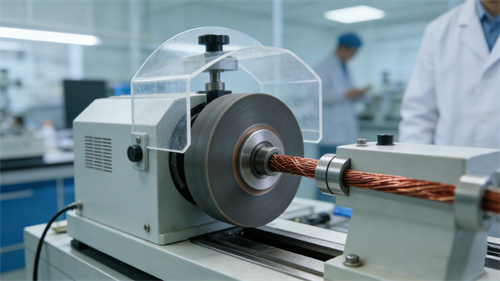
3.6 Mechanical Strength Test: Verifying the Physical Protection Capability of the Insulation Layer3.6.1 Abrasion Resistance TestAbrasion resistance test: Simulate processing/installation friction by rubbing the sample with a specified grinding wheel (cotton/steel wire) under pressure until insulation wear-through. More friction cycles = better abrasion resistance.
Process: 1) Fix the sample, set contact pressure (5N/10N); 2) Adjust grinding wheel speed/direction; 3) Run testing, record cycles when insulation fails; 4) Repeat 3-5 times, take average.
3.6.2 Flexibility Test (Bending Test)Flexibility test: Evaluate crack resistance by repeatedly bending the wire around a mandrel (5-10× wire diameter) and inspecting for post-bending defects.
Process: 1) Select mandrel diameter; 2) Perform 180° forward/reverse bends (1 cycle); 3) Set cycle count (10/20); 4) Inspect insulation for cracks/peeling with a microscope.
3.6.3 Adhesion TestAdhesion test: Evaluate insulation-conductor bonding by applying external force (winding/stretching) and checking for peeling.
Process: 1) Wind the sample around a mandrel (5 turns); 2) Gently scrape/tear the insulation; 3) Inspect for peeling—no obvious peeling = qualified; easy peeling = insufficient adhesion.
3.7 Visual and Microscopic Inspection: Intuitively Investigating Defects in the Insulation Layer3.7.1 Testing PrincipleVisual and microscopic inspection: Use the naked eye or microscope (100-500×) to check for insulation defects (cracks, peeling, bubbles, impurities, uneven coating). This qualitative test quickly identifies obvious quality issues, complementing other insulation tests.
 3.7.2 Testing Process
Process: 1) Naked-eye inspection for obvious defects; 2) Microscopic inspection (100-500×); 3) Sectional observation along the wire; 4) Record defect type, quantity and location.
3.7.3 Result InterpretationInterpretation: Qualified if no defects or defects are within standard limits; unqualified if exceeding limits (large cracks, severe peeling). Defect types help identify production issues (coating impurities, improper baking).
4. Post-Testing Process: Result Processing and Quality Control4.1 Standardize the Recording of Test ResultsPost-test, comprehensively record traceable information: sample details (batch, specification, material), test items, instrument model/calibration, parameters (voltage, temperature), environment, results and defect images. Standardize records, sign off and archive properly.
4.2 Systematically Analyze and Interpret Test Results4.2.1 Comparison of Results with StandardsCompare individual test results with standards to judge qualification (e.g., resistance vs. minimum standard, defect count vs. maximum limit).
4.2.2 Investigation of Defect Root CausesFor unqualified items, investigate root causes: raw material defects (impure coating, conductor impurities), improper production control (temperature, coating thickness), sample damage or test environment/instrument issues, to guide corrective actions.
4.2.3 Batch Quality JudgmentComprehensive batch judgment: Qualified if all items meet standards; unqualified if key indicators (breakdown voltage, resistance) fail; re-inspect or evaluate downgrade for minor non-key defects.
4.3 Formulate and Implement Corrective and Preventive Measures4.3.1 Handling of Unqualified BatchesIsolate unqualified batches immediately. Treat based on severity: rework (re-coating) with re-testing for repairable defects; scrap irreparable products and maintain records.
4.3.2 Formulation and Implementation of Preventive MeasuresDevelop targeted preventive measures for root causes: strengthen supplier audit/incoming inspection for material issues; optimize process parameters for production control issues; enhance instrument calibration/operation standards for test issues. Implement measures, regularly check effectiveness to prevent recurrence.
5. Safety Specifications for Enameled Wire Insulation Testing5.1 Safety Protection for High-Voltage TestingHigh-voltage test safety: Wear insulating gloves/shoes; no contact with high-voltage parts during testing. Install guardrails/warnings, ensure instrument grounding, and discharge samples/instruments post-test to avoid electric shock.
5.2 Prevention and Control of Electrical Safety HazardsElectrical hazard prevention: Use standard power supplies. Stop testing, cut power and have professionals repair abnormal instruments (noise, smoke, leakage); no unauthorized disassembly.
5.3 Safety Specifications for Chemical TestingChemical test safety: Operate in well-ventilated areas, wear chemical protective gear. Rinse skin/eyes with water if exposed to chemicals; properly store/handle solutions to avoid leakage/combustion.
5.4 Safety Protection for High-Temperature TestingHigh-temperature test safety: Wear heat-resistant gloves; check chamber sealing/temperature control. Cool samples/chamber to safe temperature before handling to avoid scalds.
6. Frequently Asked Questions (FAQs)6.1 What is the difference between insulation resistance test and dielectric strength test?Difference: Insulation resistance test (non-destructive) measures insulation capacity via constant DC voltage; dielectric strength test (destructive) evaluates voltage withstand limit by increasing voltage until breakdown. The former reflects overall performance, the latter detects weak points.
6.2 How to determine the frequency of enameled wire insulation testing?Test frequency: Sample conventional mass-produced wires per standard (3-5 samples/batch); increase frequency or full-test high-end aerospace/automotive wires. Temporarily increase frequency for process changes, material replacement or quality issues.
Will ambient temperature and humidity affect the test results? How to deal with it?Yes. Temperature increases reduce resistance; humidity increases cause surface moisture/leakage. Countermeasures: Control environment to standard conditions; record actual temperature/humidity and correct results if needed.
6.4 What are the differences in testing requirements for enameled wires with different insulation materials?Differences depend on material properties: Polyimide wires (high heat resistance ≥200℃) require higher thermal shock temperatures; polyurethane wires (weak solvent resistance) need mild chemical solutions. Qualification criteria (resistance, breakdown voltage) also vary by material—consult specific standards.
6.5 Is it necessary to conduct insulation testing on every batch of enameled wires?Yes. Insulation performance varies by batch due to raw materials, process and environment. Testing every batch ensures timely detection of unqualified products, protecting downstream production. Use sampling for conventional products, full-test for key applications.
7. ConclusionEnameled wire insulation testing is critical for electrical product quality and safety, covering pre-test preparation, core testing and post-test processing. Strict compliance with standards at every step (standard interpretation, sample prep, calibration, testing) ensures accurate results.
For efficient quality control, enterprises should establish a sound testing system: implement instrument calibration/maintenance, standardize operations, train personnel and implement corrective/preventive measures. This ensures stable production of standard-compliant enameled wires for diverse applications.
For technical difficulties, customized test plans or high-quality enameled wires, contact our professional team for comprehensive support and solutions.
