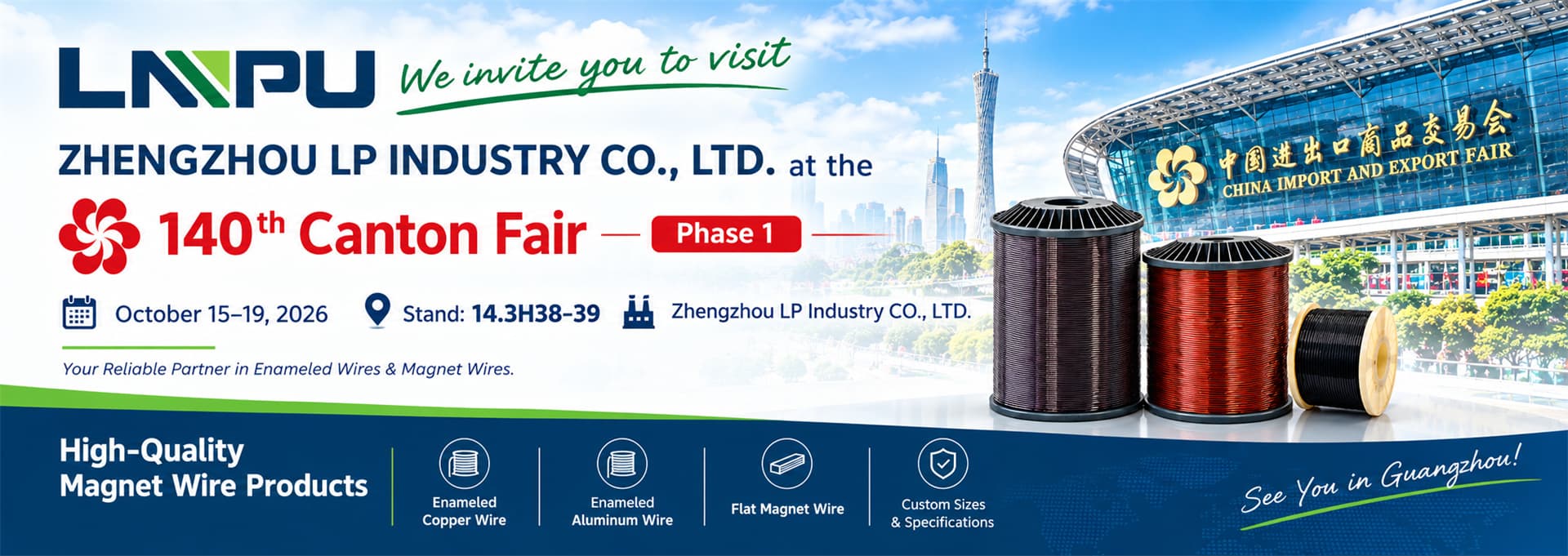
The 140th Canton Fair opens its first phase on October 15, 2026, and LP Industry will be on the floor in Guangzhou for all five days. Rather than a general introduction to the company, this page is written for buyers who are actively sourcing enameled wire: what to bring, what to ask, and what you can realistically settle at a booth before you walk out of the hall.
 1. Why the 140th Edition Is Worth a Trip for Wire Buyers
Phase 1 has always been the electrical and electronic session of the Canton Fair, which is why so much of the global magnet wire supply chain turns up in the same week. For a buyer that concentration is the real value: conductor pricing, insulation systems and delivery capability can be compared between suppliers without making three separate trips across Asia.
2026 adds a second reason. Demand driven by electrification — traction motors, charging and storage hardware, industrial drives and grid equipment — has pushed enameled wire specifications upward.
The gap between suppliers is now less about price lists and more about process control: insulation thickness consistency, surface quality after winding, temperature class verification, and whether a mill can hold tolerance on rectangular profiles. Those are things you can only judge properly by handling samples and talking to the people who make them.
2. What You Can Actually Finish at Our BoothTrade fairs are short. The aim at Booth 14.3H38-39 is to close as many open questions as possible in a single visit:
Specification matching. Hand over a drawing, a nameplate or a sample of the wire you currently use, and our engineers will identify a matching conductor, insulation type and temperature class on the spot.
Sample handling. Feel the enamel surface, check windability, compare enamel thickness and colour between grades — the tactile check that data sheets cannot give you.
Commercial framing. Indicative price bands, minimum order quantities, tooling or lead time for non-standard profiles, and packing options for sea freight.
Capacity and quality questions. Ask directly about production lines, in-house drawing capability, testing equipment, and how routine test results are documented per batch.
A defined next step. For qualified enquiries we agree a follow-up plan: formal quotation, sample dispatch date, and a named contact who stays with your file.
3. Wire Types on DisplayThe booth covers the four product families LP has built its export business on, plus our newest developments:
| Product |
Typical application |
| Enameled round wire (copper & aluminium) |
Motors, small transformers, coils, household appliances, pumps and fans |
| Enameled rectangular wire |
EV traction motors, generators and compact machines where slot fill ratio matters |
| Insulation winding wire |
Windings exposed to demanding thermal, electrical or mechanical stress |
| Continuously transposed cable (CTC) |
Power transformers and reactors where loss reduction and efficiency are decisive |
| New products |
Recently developed grades released in response to customer testing programmes |
4. How to Screen an Enameled Wire Supplier Before You VisitIf you are comparing several stands during Phase 1, these six questions separate a mill from a trading company faster than any brochure:
Ask who draws the conductor. A supplier that controls its own rod and drawing process has far more influence over dimensional tolerance and surface finish.
Check insulation consistency, not just insulation type. The same grade number from two suppliers can behave very differently after winding.
Confirm the temperature class in writing. Class 130, 155, 180, 200 and 220 are not interchangeable, and the certificate should match the product you actually receive.
Test windability on a real sample. Ask for a piece you can bend, wind and strip back in your own laboratory.
Ask how batches are traced. Routine test records per batch are the difference between a repeatable product and a lucky one.
Talk about lead time under load. A normal delivery time means little on its own; ask what happens in your peak season.
5. Bring This Information to Your MeetingBuyers who arrive with the following details usually leave the booth with a usable quotation instead of a general catalogue:
Conductor material and nominal size, with the tolerance you accept
Insulation type and grade, plus required temperature class
For rectangular wire: width, thickness, corner radius and any profile drawing
Estimated annual volume and first order quantity
Delivery destination and preferred Incoterm
Certification, labelling or packaging requirements
